Former Estonian president speaks about the war in Ukraine and the way forward
Former Estonian president speaks about the war in Ukraine and the way forward
- By Admin --
- Thursday, 02 Jun, 2022
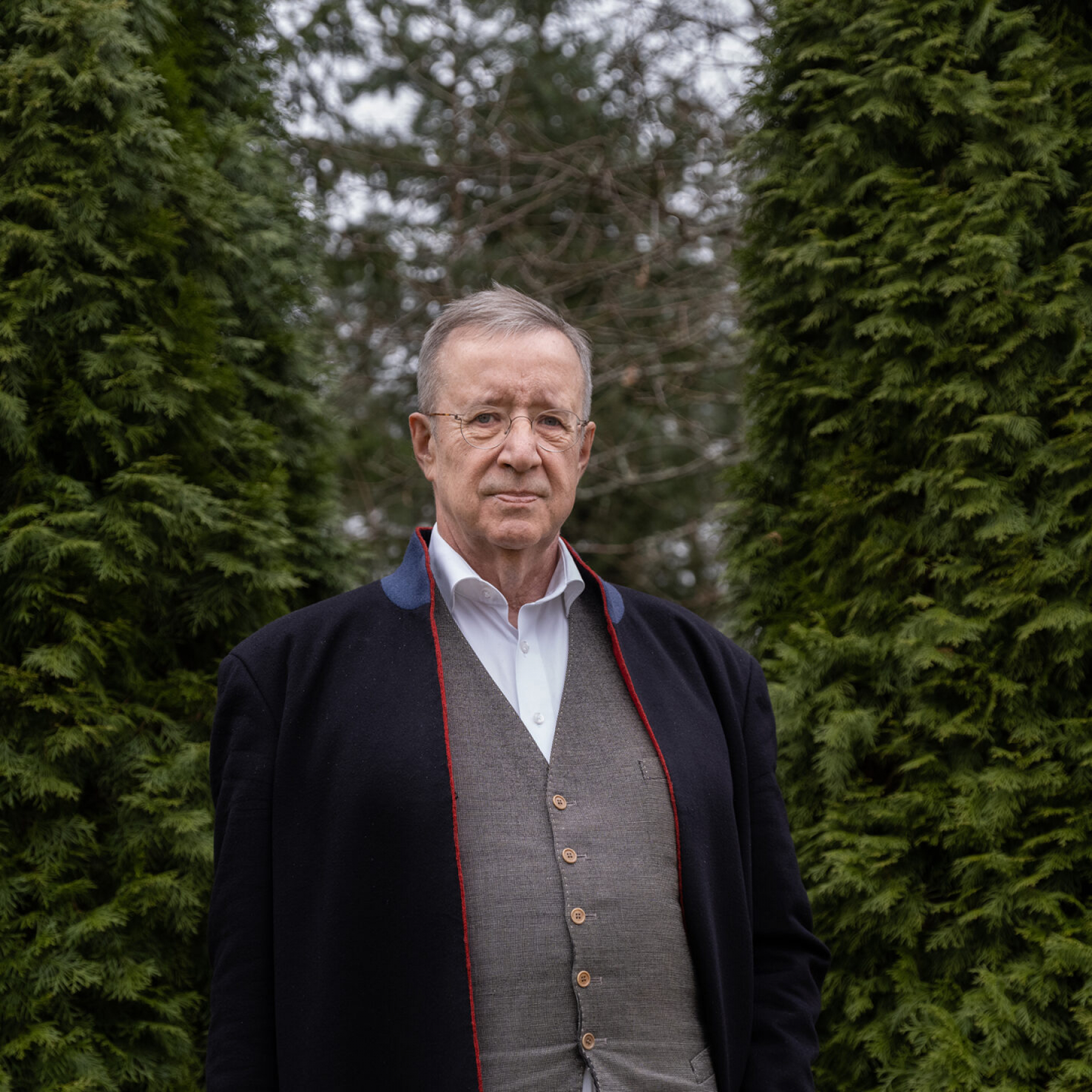
VILJANDIMAA, Estonia — Just a couple hours' drive from the border with Russia, the former president of Estonia lives on the farm his family built in the 1700s — a farm whose occupants were forced to flee in times of conflict, and which now serves as a refuge for victims of another war.
Toomas Hendrik Ilves, who served as Estonia's president from 2006 to 2016, has long acted as a prominent voice warning about the dangers of Russian aggression.
Those warnings have recently come true, and Estonians have sprung into action. On Feb. 24, when Russia invaded Ukraine, Ilves flew a Ukrainian flag at the family farm, and, within weeks, found himself hosting a family of Ukrainian refugees. Meanwhile, Estonia as a whole has pledged the most military aid of any country relative to its GDP.
In late April, a couple of months into the war, Ilves spoke with on his family farm about his perspectives on the conflict, the history — of both his family and his country — that led Estonia to be one of Ukraine's biggest supporters, as well as his ideas about the future of the conflict.
The invasion
To Ilves, and many others in the Baltic region, Russian President Vladimir Putin's decision to invade Ukraine was not a surprise — though Ilves recognizes that wasn't the case in the rest of the world.
Estonia and neighboring Latvia and Lithuania, occupied by the Soviet Union until the early 1990s, have a "we told you so narrative," Ilves explained — having made predictions that Russia would continue to act out if left unchecked, particularly after invading Crimea in 2014.
Ilves said Estonia is "used to being attacked," making the tiny Baltic nation more psychologically prepared for the latest incursion. Plus, when Ilves served as president, he met both Putin and his predecessor, Dmitry Medvedev. Ilves said he knew to expect the unexpected with these leaders, because Russia is not a "rational" country in terms of decision-making.
Estonia's support for Ukraine also stems from previous Russian atrocities that residents in the region still remember.
Ilves's family comes from the Mulgimaa region in Southern Estonia, which was once fairly poor and rural. However, when the U.S. Civil War broke out in the 1860s, the global demand for flax seed rose, and many farmers in Estonia became wealthy. That success ultimately made those wealthy farmers targets of the Soviets, resulting in multiple deportations in 1941, 1945, and 1949; Ilves's family were among those who fled. His parents both independently escaped to Sweden, where they met and where he was born.
Ilves credits the Estonian response to the invasion to these deep, emotional connections. "We know what it's about," he said.
But recent events have also highlighted the stark differences in perspective, llves believes, between Western Europe and Eastern Europe. From his view in Estonia, while the threat of Russian aggression never really faded, it surged into front of mind way back in 2007, when Russia launched a massive cyberattack against Estonian websites.
Ilves recalled going to a NATO meeting to address the denial-of-service attack, one of the first major nation-on-nation digital strikes, and he said that at least one NATO ally claimed Estonia was being "Russophobic."
From that point on, he watched as Russia invaded Georgia in 2008 and Crimea in 2014.
"They said, 'No, the Estonians are just suffering from post-Soviet traumatic stress,' dismissing us," said Ilves.
When Germany supported the Nord Stream Two, a natural gas pipeline worth $11 billion that would double the volume of cheap Russian gas flowing to Germany, rather than diversify energy sources beyond Russia, Ilves took that as a sign of a "lack of consideration really for the concerns of fellow members of the European Union and NATO." (Construction was halted in late February, just days before the full-scale invasion.)
"This kind of attitude we've had to deal with for 30 years ... more than 30 years," he said. "It's very much an issue of 'I told you so' ... which I think explains certainly why countries like mine and Latvia, Lithuania, and Poland are contributing far more.
Russian propaganda
Ilves says what's actually been surprising about the invasion is "how bad the Russian army is" — though he says it makes sense that Russian soldiers might have an inflated sense of confidence, following earlier "victories" in Georgia and Crimea, and because their own propaganda might have infected their ranks.
"They were surprised the Ukrainians didn't meet them with flowers for being liberated," he said. "You know, it's kind of like, don't do your own stash," referring to drugs, or the phrase, "don't get high on your own supply," popularized by the 1983 American film "Scarface."
What he means is that Russian officials have been insisting so long that they're only out to rescue oppressed Russian minorities across the former Soviet Union. Because of that, they may not have anticipated the staunch Ukrainian resistance to being invaded.
"You start believing what is just a propaganda line," he concluded.
Russian officials also like to suggest that liberal democracies simply can't succeed in the former Soviet Union, due to cultural differences, said Ilves. Estonia, which has become increasingly wealthy and modern in the last 30 years, is seen as an aberration, said Ilves, when it should be seen as an example of what's possible.
Even so, even parts of Estonia remain vulnerable to Russian propaganda, including Narva, a city on the border with Russia where many ethnically Russian people still live and where there are still supporters of the Putin regime, despite the invasion.
In Europe, the challenge of perception is real, Ilves says. Russian propaganda painting Eastern Europe as backward and corrupt, Ilves believes, has been successful in Western Europe.
"I think Ukraine has been a sort of a big victim of this kind of disdain," he said.
But despite corruption and flaws present in the government, Ukrainians are fighting to defend their liberal democracy, Ilves said, and he believes they deserve the support of likeminded countries.
"They clearly need heavy arms," he concluded.
Related News