EU leaders endorse watered-down ban on Russian oil excluding pipeline imports
EU leaders endorse watered-down ban on Russian oil excluding pipeline imports
- By Admin --
- Tuesday, 31 May, 2022
After several hours of face-to-face wrangling, EU leaders have agreed to ban most Russian oil from the bloc's market by the end of the year.
The embargo will target only seaborne imports, while excluding pipeline supplies.
The breakthrough was announced on Monday by Charles Michel, president of the European Council, shortly before midnight on the first day of an extraordinary summit in Brussels.
"This is a remarkable achievement," said Michel. "We need political leadership in these extraordinary times."
"More than ever," he added, "it's important to show we're able to be strong and tough to defend our values."
The measure is part of the sixth package of EU sanctions in retaliation for Russia's invasion of Ukraine.
The latest raft also includes the expulsion of Sberbank, Russia's largest bank, from the SWIFT system and the backlisting of individuals involved in the alleged war crimes committed in Ukraine.
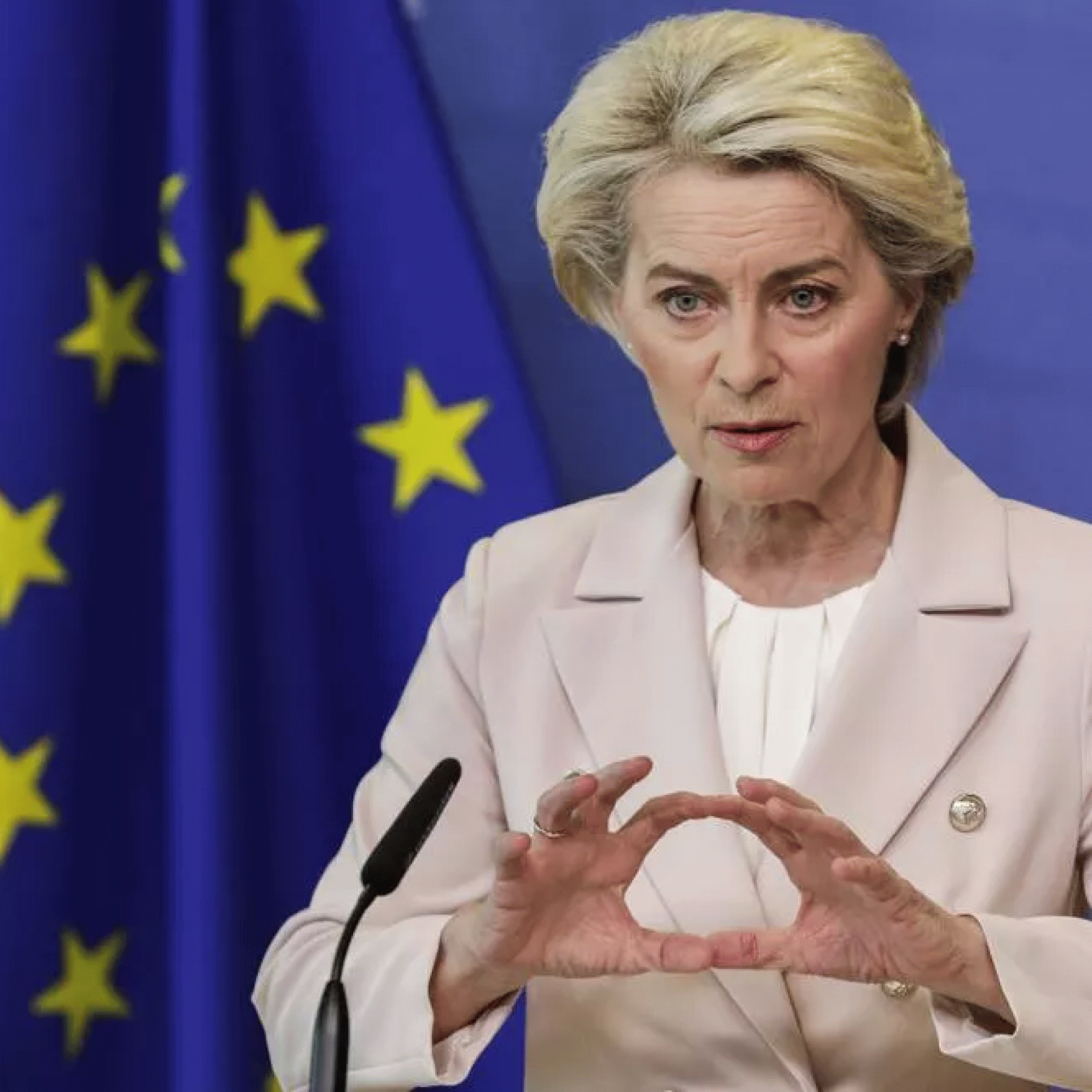
The original oil ban unveiled almost four weeks ago by Ursula von der Leyen, the president of the European Commission, targeted both seaborne and pipeline imports, with a phase-out planned by the end of the year.
But soon after von der Leyen's announcement, several member states, including Hungary, Slovakia, the Czech Republic and Bulgaria, raised concerns and asked for tailor-made exceptions to have more time to adapt their refineries and cushion the economic impact.
EU sanctions require the unanimous vote of all 27 member states.
Following several rounds of intense and unsuccessful negotiations, a compromise was reached to exempt all oil imports coming through pipelines.
Around two thirds of Russian oil imported to the EU is shipped from ports, with the rest coming directly from the Druzhba pipeline, a massive conduit that directly feeds refineries in Poland, Hungary, Slovakia, the Czech Republic and Germany. These refineries have for decades grown accustomed to the reliable and comparably cheap deliveries of a specific type of Russian oil.
Speaking next to Michel, President von der Leyen said that, by the end of the year, over 90% of Russian oil will be targeted based on individual commitments made by Poland and Germany, who have pledged to ban their imports from Druzhba's Northern branch.
Leaders have agreed to revert "one way or the other" to the topic of the remaining 10 to 11% of imports coming through the Southern branch, von der Leyen said, without providing a specific date.
"We still have to work to do," she said. "It's a big step forward what we did today."
The pipeline derogation is seen as an important victory for Hungary's Prime Minister Viktor Orbán, who on Monday said the exemption was a "good approach". He castigated the Commission for proposing sanctions before "solutions," referring to his country's specific circumstances.
His staunch opposition, however, has ruffled some of his fellow leaders.
"[Hungary] plays Moscow's game. They didn't convince us their objections are technical in substance," a senior diplomat told news.
Orbán's hard-fought tweak provides an important cover for all the other countries dependent on Druzhba, who feared the sudden switch to other providers would be highly costly and disruptive.
Despite the amendment, the step taken by EU leaders on Monday evening represents the boldest and most consequential in retaliation for Russia's invasion of Ukraine.
Fossil fuels are the Kremlin's most profitable source of revenue and provide a lifeline to sustain the declining economy and bankroll the costly military campaign.
The EU is Russia's number one oil client, providing over a quarter of the bloc's total needs.
Pre-war figures indicate the EU buys, on average, around 2.2 million barrels of crude, together with 1.2 million barrels of refined products, on a daily basis.
Since the onset of the conflict on 24 February, member states have spent about €30 billion on Russian oil, according to a tracking tool set up by the Centre for Research on Energy and Clean Air (CREA), an independent research organisation.
Given this high degree of energy dependence, the decision is expected to inflict pain also on European households and companies, who have for months been struggling with soaring bills.
After Monday's political endorsement, ambassadors are expected to meet and put the finishing touches. The embargo will enter into force once the final version is published in the EU's official journal.
Exempting pipeline oil while banning seaborne imports is likely to raise questions about unfair competition across the single market because some member states will still be able to receive reliable and affordable supplies while others struggle to secure more expensive crude barrels from non-Russian providers.
Food security in focus
The summit's first day began on Monday at 4 PM (CET) and focused on the Ukraine war and the country's immediate financial needs.
The EU is working on macro-financial assistance to provide loans worth €9 billion and is debating ideas on how to fund Ukraine's post-war reconstruction, including through the confiscation of Russian-owned assets.
Ukrainian President Volodymyr Zelenskyy addressed the leaders via video conference. The Ukrainian leader revealed on Telegram that during his speech he said that "Europe must demonstrate force" and called for unity and solidarity.
"Greater solidarity is the foundation of this force. And you know it. Finally, any friction in Europe must stop, internal friction that only encourages Russia to force more on you," he wrote.
The extraordinary summit will continue on Tuesday with the intervention of another foreign representative: Senegalese President Macky Sall, who is the current chairperson of the African Union.
President Sall will bring the African perspective to discuss the exacerbating food crisis resulting from the war.
Ukraine is one world's leading exporters of wheat, corn, barley and sunflower oil, but a Russian blockade of the Black Sea has prevented the country from exporting supplies to global markets.
Ukraine is storing around 40 million tonnes of grain, half of which must be exported by the end of July.
EU leaders will weigh in on how to make this possible by setting up alternative trade routes, an effort that would entail serious economic and security implications.
Russian President Vladimir Putin has said he is willing to help overcome the food crisis if the "politically motivated" sanctions imposed by the West are lifted.
Ursula von der Leyen said talks to unblock the Black Sea are "ongoing" and accused Russia of being" responsible for the starvation of millions of people."
Related News